How plants and naturals systems are the future of design
With the climate issues we face today and the scarcity of water in places with reduced rainfall there has been advancing infrastructure in water systems, such as treatment plants and desalination. However, the drainage systems in place are aging and lack the capacity required. Due to the rapid urbanisation of cities around the world flooding is becoming an increasingly large issue, because most cities are lacking the complex infrastructure required with the growth in urbanisation (Willems, 2012).
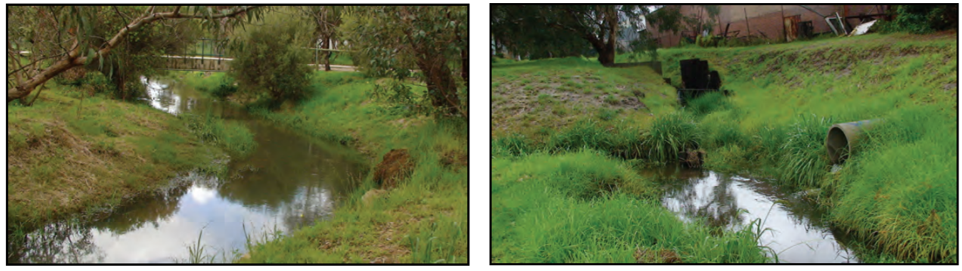
Throughout Perth there are drainage sumps and pits for when there is too much run off for the infrastructure to handle at that time. This can cause issues to the surrounding environment where the runoff can get into waterways or effect wildlife. There have been instances where these storm water drains have had contaminants above the Australia and New Zealand Environment and Conservation Council trigger values (ANZECC & ARMCANZ 2000) and at one location there were traces of PCBs that are banned in Australia. With additional rainfall this could have a big impact on the surrounding environment or ecosystems, we need to find ways to reduce the amount of water going to drainage sumps and find ways to improve the water quality going to these storm drains.
However not all cities use this method, Elizabeth in the TED talk below explains how in places like New York and older cities around the world this combined run off- sewage water goes back into the water ways untreated. The sewage contains pathogens and chemicals that then create a water quality issue at these run off outfalls.
“There is a water quality threat, caused by a water quantity issue”
Elizabeth Fassman-Beck
So by reducing or slowing down the amount of runoff in urban areas, we will be able to lower the environmental impact and water quality issues caused by the flooding of our systems and the overuse of drain sumps and outfall systems.
So what are green walls?
Green walls and roofs have been around since the 1930’s, but the first successful large indoors green wall was created in 1986 at the Cité des Sciences et de l’Industrie in Paris. Since its conception in the 30’s the idea has grown and now green walls and roofs are being used in the designs of buildings over the world.
We may think that this idea is innovative, sustainable and beneficial and should be implemented on buildings all around the city. However, there are many factors that need to be considered to make the green wall work, such as drainage, climate and plant type.
The issue with green roofs is that the building needs to be equipped to handle the drainage, so that a large amount of water isn’t retained on the roof which could affect the building and plant health through water logging and oxygen depletion. To avoid this issue buildings need to have a run off drain that then goes to a storm water collection in the building. However, if there isn’t a capacity for this the roof needs to have a root-proof water proof membrane implemented and drainage outlets that allow the run off to flow into the roofs guttering.
The type of vegetation that can be used will vary depending on the climate and rainfall in the area, however there are websites and guides to determine what would be most suitable. The time of year the wall or roof is planted is also important as establishment irrigation might be needed. This basically means that it will need to be watered for a couple of months to allow the plants to establish once planted and to get used to the conditions on the roof. Therefore, planting in winter or autumn is best to reduce the amount of irrigation needed by allowing rain to help establish the plants.
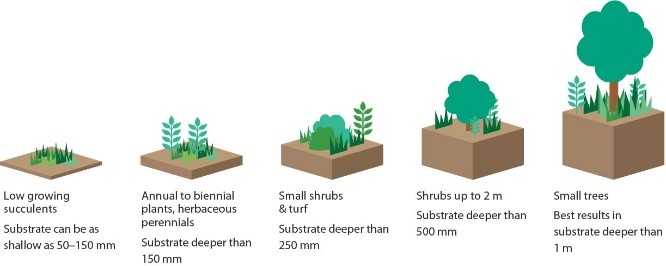
Due to temperatures, wind exposure and sun exposure the correct type of plants is very important for the success of a green roof . They can be categorised by substrate depth, which is dependent on how the roof is constructed. The substrate depth and the types of plants used is important if you are wanting and intensive or extensive roof. Determining if the roof type will be intensive or extensive will depending on the structural capactiy as the additional soil makes the green roof a lot heavier.
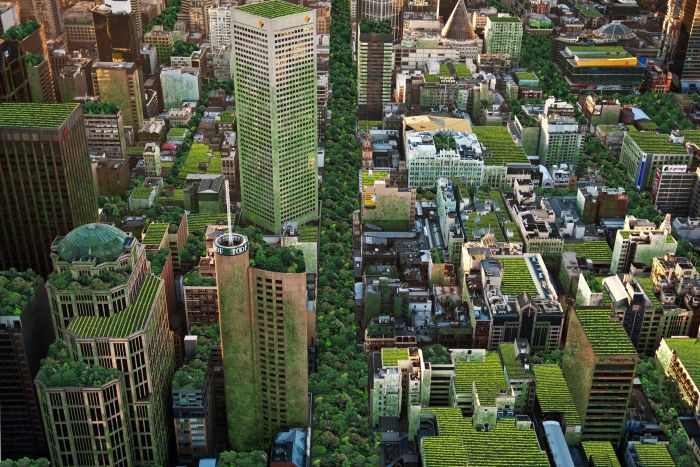
Green roofs and walls can be implemented all over cities and on houses. In locations that don’t allow for the roof they can be made along the pathways so that they will still help slow down the water run off into the drain. This would also be easier as paving is being replaced or new suburbs are built the verge can have trees and plant beds put in to help with the drainage systems.
So how can these green roofs and walls impact us?
What are the positive impacts?
As we can imagine there are multiple benefits to having green infrastructure around our cities.
- It helps infrastructure and drainage but reducing and slowing down run off water
- Helps improve water quality and the effects of pollutants on the environment
- Brings down the temperature of the building and surrounding area by countering the heat island effect. Researchers have found that it could reduce the temperatures but 3-11 degrees Celsius, with a greater impact in warmer temperatures.
- Provides a natural ecosystem for birds and insects, by providing an environment for wildlife
- increases air quality in the surrounding area
- Saves storm water from the runoff, Which can be then reused in the building or for irrigation during dry weather.
- Reduces energy consumption of the building
- Increases livability of the area as people like the greenery in the urban setting
- Can incorporate solar panels into the design for further saving on energy
Overall we can see that these things will have a dramatic impact on the surrounding environment and will even save the building money in terms of energy consumption and water usage, but do they help with the drainage?
Studies have been done a precipitation models show that overtime having a green roof could decrease annual water run off by up to 20% from only having a couple of mm of storage (Locatelli et al., 2014) , which shows that implementing these will have a big impact on our future drainage systems.
The Negatives of living walls
Quite a lot needs to go into the implementation of a green wall and roof if the building wasn’t designed to equip them. One of the main reasons for this is how it effects the structural integrity of the building. The irrigation, soil and plants weigh quite a lot on their own, so when it rains and you add in the weight of the water this is a large load for a roof to bare if not designed for it. Thin lightweight or Extensive roofs which are 2 to 6 inches deep should work on most roofs, but intensive roofs of 6 to 18 inches would need more structural support.
Green roofs are also limited to certain roof designs, due to the angle of some roofs. Typically green roofs are only capable up to 25 degrees slope, however some new techniques using erosion control in Europe has made roofs of up to 45 degrees a possibility.
Of course the thing that is most typically the deciding factor is the price and the fact is that green roofs can cost thousands of dollars more than a normal roof. The start up cost of the irrigation, water proofing and then the plants them selves dramatically increases the cost of a roof. There is also an ongoing cost of looking after the roof and protecting it from insects and bugs.
The future of design
We can see that there are many benefits to having living wall implemented into the design of cities and the negatives being limited to cost and structural integrity. However, if this cost is included in the design of future buildings then it wouldn’t be such a drawback and the benefits would be more apparent. The buildings that have the roofs implemented are seeing the benefits in lower energy consumption and costs. With the development of implementation techniques and new technology the cost of green roofs is becoming less of a factor and they are slowly becoming more apparent in designs. There is still a large way to go though, so that a city can truly benefit from the advantages and not just have one building that has a slightly lower temperature and reduction in run off.
There are many cities over the world that are making it a requirement to implement green walls and roofs on building of a certain size and nature. Designing buildings that will be sustainable and help with reducing the impact on the environment should be promoted more, so by spreading the benefits of green walls and similar systems this will hopefully help speed this up. So as green infrastructure becomes more widespread as well as knowledge of the benefits it can have on our cities, hopefully we will start seeing changes in the way we design and an increased focus on how it will effect our future.
Additional Articles and References:
CENTRE, T. G. R. Guide to DIY Green Roofs.
DOWNTON, P. 2013. Green Roofs and Walls [Online]. Available: http://www.yourhome.gov.au/materials/green-roofs-and-walls [Accessed 20.3.19].
FASSMAN-BECK, E. 2018. Green Infrastucture for Runoff [Online]. Available: https://www.youtube.com/watch?v=jAenu6Vshs8 [Accessed 18.3.19].
GARAGE, G. 2019. 7 pro and cons of Green Roofs [Online]. Available: https://greengarageblog.org/7-pros-and-cons-of-green-roofs [Accessed 25.3.19].
GUIDE, G. G. 2013a. Drainage Layers [Online]. Available: http://www.growinggreenguide.org/technical-guide/construction-and-installation/green-roofs/drainage-layers/ [Accessed 20.3.19 2019].
GUIDE, G. G. 2013b. Green Roof Plants [Online]. Available: http://www.growinggreenguide.org/technical-guide/design-and-planning/plant-selection/green-roofs/ [Accessed 22.3.19].
GUIDE, G. G. 2013c. Vegetation [Online]. Available: http://www.growinggreenguide.org/technical-guide/construction-and-installation/green-roofs/vegetation/ [Accessed 20.3.19].
HUNKER 2019. Disadvantages of Green Roofs.
LOCATELLI, L., MARK, O., MIKKELSEN, P. S., ARNBJERG-NIELSEN, K., JENSEN, M. B. & BINNING, P. J. 2014. Modelling of green roof hydrological performance for urban drainage applications. Journal of Hydrology, 519, 3237-3248.
NPR. 2017. Do Cities Need More Green Roofs? [Online]. Available: https://www.youtube.com/watch?v=FlJoBhLnqko [Accessed 20.3.19].
ROOFERS, G. 2016. Advantages and Disadvanteages of Green Roofs [Online]. Available: http://www.greenroofers.co.uk/green-roofing-guides/advantages-disadvantages-green-roofs/ [Accessed 20.3.19].
WATER, G. O. W. A. D. O. 2009. A snapshot of contaminants in drains of Perth’s industrial areas.
WIKIPEDIA. 2019. Green Wall [Online]. Available: https://en.wikipedia.org/wiki/Green_wall [Accessed 20.3.19].
WILLEMS, P., ARNBJERG-NIELSEN, K., OLSSON, J. & NGUYEN, V. T. V. 2012. Climate change impact assessment on urban rainfall extremes and urban drainage: Methods and shortcomings. Atmospheric Research, 103, 106-118.
 Adapt
Adapt 
This was really informative! Love the idea of green walls, but I hadn’t even thought about the costs associated with upkeep and the fact that existing buildings may not even be able to support them. Hopefully in the future more countries will see them as a worthwhile investment.
LikeLike
I really enjoyed reading this blog. I like how you spoke about both the positives and the negatives of green roofs/living walls. The videos you placed throughout your blog were great as well, really helped get the key points across.
LikeLike
A really informative blog! i would love to see more of the green infrastructure and its benefits integrated into our Perth infrastructure
LikeLiked by 1 person
Building corridors for insects and birds within cities ❤
I wonder if you could also use roof space for urban farming?
LikeLike
I know a bar in Perth which owns a farm on a neighbouring roof which they use for fresh ingredients and I think they’re wonderful ideas. I’d love to see these green walls incorporated more in the CBD, it definitely makes a city more visually enjoyable to walk around.
LikeLike